July 11, 2011

Tyler at Old Man's Cave


Tyler at Old Man’s Cave


all those favorite days
how I love to think on them
the sun was shining
and warmed my arms, my head
the caves welcomed us
you ran free in wonderland
your dog essence
overflowing with happiness
as I followed behind you in wonder
I placed you on a high ledge
in the sunshine, my small dragon
and you seemed to be in heaven
in your presence, I felt safe in the woods
nothing bothered me, then


July 6, 2011

Creation of a Book Cover: "My Beginning" by Melissa Kline


The very best part of the work I do is creating book covers…there's nothing I love more than this part of the publishing process. Today, I'd like to share with you the steps to creating the paperback cover for
My Beginning, a young adult novel (sci-fi) by Melissa Kline, published July 1, 2011 by Lucky Press, LLC.

Melissa is a very creative person, not just with words but also with art and craft materials. She is a miniature artist and has displays in the Denver Museum of Miniatures, Dolls, and Toys, coinciding with the release of My Beginning. Melissa's enthusiasm for all things creative made creating the cover of My Beginning even more fun.

My Beginning tells the story of 16-year-old Ivory, a blonde-haired girl who lives confined in an "institution" -- a place where many children live under the watchful eyes of mother-nurses. The children are not allowed to go outside, for they are told that if they do, they will immediately die, due to a plague that has almost wiped out humankind. Ivory meets Aidan, the first teenage boy she has ever been interested in and the only one of her friends who did not spend his whole life at the institution. After receiving harsh punishment for her relationship with Aidan, Ivory escapes with Aidan into the unknown world outside of the institution and that is her "beginning."

The scene I choose to illustrate, after talking with Melissa, was just after Melissa and Aidan open an old rusty door and emerge into a beautiful wooded area. Here's how I did the cover:

I began with a pencil drawing of how I envisioned Ivory and the woods.


Then, I colored the drawing using a technique that works well for me. First, I color in the major color shapes with Sharpie brand markers. Then, I go over that, in detail, with Prismacolor colored pencils (I use no other brand, as Prismacolors have the best wax content for blending, IMO). Here is a photo of the work in progress:


I saved coloring Ivory until last because I knew her dress would be white and her skin light and I didn't want that part of the drawing to get scuffed or "dirty" while I did the brighter colors. Here (at left) is a detail of Ivory once I have colored her figure.

After the drawing is completely finished, I scanned it with my Epson scanner. Because the drawing was larger than the scanner bed, I had to scan in two sections then merge the sections carefully in Photoshop. (On day I hope to have a larger bed scanner, but they are quite expensive!)

After scanning the photo, I convert it from RGB format to CMYK, the format required by book printers. I also reduce it to fix the dimensions of the finished book (5.5 x 8.5 inches) with an additional 1/4 inch on all sides for necessary bleeding of the image off the edge, to allow for the book to be trimmed to size at the printer's.

So, at this point, I have the illustration in my computer and sized to the correct size for the book cover. But, that is just the end of one phase; it is not yet ready to be a bookcover. This is the point at which many designers new to cover design or author's self-publishing and doing their own covers stop, put on a title and author's name and call it a day. But, by thinking more about the characters and story and letting them speak to you (I know it sounds weird, but it works for me) and also loving the process and the wonderful things you can do in Photoshop, yet knowing how to keep things simple…well all these things are learned by experience and become intuitive to the experienced designer. I have been designer, publisher, or production manager on over 200 books, and finally feel I can trust the process at this point. I dislike being rushed in the creation of the cover; it seems such an organic process. Often what happens is I'll be doing other things, and suddenly this compulsion to work on the cover whispers its way into my consciousness. I'll leave everything else and go to my computer (or drawing pad) and out comes the cover; it seems to pour out from whatever soup was brewing just under my level of awareness. Anyway…. the finished, colored drawing is shown at the top of this post.


Here is my first attempt at making a cover using the illustration. As you can see, it is not well integrated, color-wise or design-wise. It just does not have enough "umph" and the structure of the design does not lend itself to the open, hopeful feeling of Ivory's discovery of the world beyond the institution.

One thing I do like about this cover (at left) is that I choose to use some of the "artistic filters" in Photoshop to bring out the edges of forms in the drawing and enhance the illustration beyond my hand-work. Below, you can see part of this process.


Melissa mentioned the surface of an old white file cabinet; she thought it would work well for the background. I started wondering if I could drag one of Lucky Press's old metal cabinets outside and create a rusty surface using water and the yucky snowy weather we were having here in Ohio at the time. Lucky for me, I had been introduced to Dreamstime stock photos by another wonderful author, Chuck Zigman, who wrote The World's Coolest Movie Star (and another book that I'll write more about this fall).


Here are three textures I liked for this cover. I choose to go with the third one, at bottom left.

Below is the cover as it stood after merging the illustration with the textured background and after I added in the title and author's name. Still, something was not quite right...


Melissa had the wonderful idea of having the illustration show through a keyhole shape and also of having some sort of rusty looking texture behind the illustration. (You are seeing now just how collaborative this cover design process was… our ideas bounced off one another and made the whole process seem not like work, but like a creative adventure!) Here is my third version of the cover with the keyhole and with new fonts for the title (Melanie BT) and author's name (Gil Sans Condensed).

At this point, I knew we had nailed it, though some might think otherwise. Popular YA covers may feature photographs and quirky drawings, but this cover aims to capture the themes of confinement, freedom, nature versus machine, and the innocence and hope of a teenage girl.

After the front cover was completed, it was time to work on the "mechanical": the entire cover layout as it is sent to the printer. Melissa and I fine-tuned the back cover text (synopsis) and chose the reviews that would appear. I obtained the EAN barcode and confirmed the spine width with the printer. Here is the full mechanical for My Beginning.


One of the great reviews we chose to use on the back cover was by Terry Matalas. "Terra Nova" premieres on FOX Sept. 26, 2011 and sounds like a great show, too!:

"Kline has woven a rich tapestry of romance, science fiction, and adventure. Ivory's journey through an Orwellian post-apocalypse grabs hold of you and never lets go." ~Terry Matalas, television writer, FOX TV "TERRA NOVA"

As I mentioned, Melissa creates miniature scenes based on her novels. The final picture here today shows one of the miniatures she created for My Beginning as it displays in the Denver Museum of Miniatures, Dolls, and Toys.

My Beginning is now available in paperback from Amazon, Barnes and Noble and through your favorite bookstores. It is also available in Kindle format from Amazon. You can find Melissa Kline's blog, "Reflections on Writing," at THIS LINK and you can friend her on Facebook at THIS LINK. Her photo (by Anissa Long Photography) is below.


Lucky Press is online at www.luckypress.com and you can learn more about my artwork at www.janicephelps.com/illustrations.htm.


July 4, 2011

Discovering Relatives in the American Revolution and More!


A few months ago I decided on a whim to sign onto Ancestry.com to see if I could learn anything more about my family history. I've always thought our family to be very small and without much in the way of "roots."

My father, Woodrow Wilson Phelps (1913-1990) was orphaned by age 4 and raised by his grandparents, the youngest of four children and always, it seemed, surrounded by the cloud a great loss endured so young might cause. My mother's parents were an active part of my childhood, but still, there were mysteries surrounding her paternal grandparents. Could Ancestry.com help me solve these mysteries?

I signed up for the 14-day trial and became so engrossed in the search the first week, that I signed up for a 3-month subscription. This would keep me hooked into the research and "leaf hints" through my mother's visit to our home this past month.

For a very reasonable price and not much time, really, I have learned so much about our family history and assembled a rough sketch of a family tree that I look forward to putting in some sort of artistic-like form (a large drawing, a scrapbook, etc.). The "small family" I've complained about my whole life is actually much larger than I realized and as I've learned about the various members whose actions and genetic make-up and choices have impacted my life today, I have learned a bit about history as well... and this has also affected my reading choices over the last few months. Suddenly, history is coming alive to me.

Here are a few things I have learned:

MY MOTHER'S FAMILY:
Relatives on my mother's side have been in America since the late 1700s. Family names: Greene, Nichols, Ague/Aga, Daily. That's my grandmother, Helen Ora Nichol in the photo at left.

Frederick Ague was born in 1746 in Germany and his wife Catherine died in Bedford, PA in 1776. Their son, Nathan Ague, was in the War of 1812, in the Ohio Militia. Nathan's son, Nathaniel, was in the Civil War and is buried in the National Cemetery in Little Rock, Ark. I've seen a photo of the cemetery.

Nathaniel's brother, Timothy Ague (1836-1903) was my 2nd great grandfather. My mother remembers his wife, Mary Martha Dailey (1840-1938), who told Mom of coming to Ohio from Pennsylvania at age 6 in a covered wagon. She had 11 older brothers who fought in the Civil War. One of them, surviving the War, died when the balcony of a hotel he had stopped at on the way home after the war, collapsed.

My mother's paternal side of the family (Greene, Hartzell, Lathrop) is still lost to us, as I could get no further than her grandparents... Still, it was very cool to see the Census report from 1900 with my grandfather's name at age 4 on the ledger, along with his parents and sisters.

MY FATHER'S FAMILY:
My father's side of the family, surprised me! I had thought this side of the family would be lost to me, because I've always thought since his parents (Hattie Terry and Guy Phelps, shown at left) died a year apart when their youngest son was a toddler, there wasn't much story there. Silly me! So much to discover...

I was able to trace my father's family back to the 1400s: to my 16th great grandfather Saloman Lyman (1404-1495) and to my 13th great grandfather Francis Phylppes (1460-1491).

The Lymans can trace their genealogy back to "Charlemagne, Pepin, King of Italy with sundry other kings, noblemen and noblewomen," and it stunned me to see the pages of text documenting who married whom and all their children way back to, well, Charlemagne. Jeepers. I was more impressed with record keeping and the institution of marriage than possible connections to fancy people. I'm interested in courageous people, strong women, and brave men, intelligent for their time, questioning and curious. This is what I would like to think is in my genetic make-up, whether the steelworkers, farmers and bridge builders on my mother's side or the New England founders and descendants of prominence on my father's side.

Regarding the Deweys:

The Dewey lineage can be traced with some degree of accuracy, according to ancient Saxon Chronicles, to the Saxon cult hero, who is almost a myth, called variously Vothinn, Othinn, Odin, Bodo and Woden, king of the West Saxons during 256-300 A.D. This king Woden, the god of war of the southerly Germans, is described as the great-great-grandfather of the bugaboos of English history, Hengist and Horsa, brothers, freebooters and pirates. The Saxon annuals relate that Hengist was king of the Saxons and died between 474 and 495 A.D. and was the first king of Kent.

From Garber-Zent Genealogy. The author notes: This material is based mainly on the account of the royal ancestry of Admiral Dewey as reported in "The Life of George Dewey, Admiral, US Navy, and the Dewey Family History", by Adelbert Dewey, 1898.


My father's family had these main lines: Phelps/Phylppes, Weirman, Terry, Dewey, and Lyman:

* My 10th great grandfather, John Dille/Dilley, was born in England in 1600. He died at Jamestown in 1660. I wonder if he knew Capt. John Smith and saw Pocahontas! Thanksgiving will never seem quite the same to me...

* John Ingersoll (1615-1684, my 8th great grandfather) was born in England. He came to America with his brother in 1629 and lived for a while in Salem, MA, before moving to Hartford, CT, and marrying Dorothy Lord, daughter of one of the founders. Dorothy gave birth to three daughters and died at age 26. John's second wife died after giving birth to four daughters. So, here was a widower with 7 daughters and it's understandable he married once again. (I can imagine a YA novel about those 7 daughters! Also, Salem, MA in the mid 1600, yikes!)

* George Phelps arrived in America about 1630 in MA. His son, Jacob, married Dorothy Ingersoll, John's daughter.

* The Lyman's arrived in America in 1631 from Essex, England. Richard Lyman (1580-1642) was my 10th great grandfather. He and his wife were part of a group of 25 people who founded Hartford, CT. I found a photo of a monument there with Richard's name on it.

* William Dewey (1692-1759) was a minuteman in the American Revolution, a corporal in the Continental Army. William's daughter, Hannah, my 5th great grandmother, married Silas Phelps.

* William Wierman was born in Germany (1700) and his wife Gertrude Stateman was born in Holland (1705). They died in York, PA in 1766, ten years before our country was born.

* My 4th great grandfather, Eleazer Heath (1754-1850), was a soldier of the American Revolution, lived to age 96, and is buried in Williamsfield Center, Ohio.

* Another 4th great grandfather, Eliphalet Phelps (1743-?) served in the 18th Regiment, CT Militia, detailed for service in NY state from August to Sept. 1776. He also served under capt. Oliver Lyman's Co. and marched from Northhampton to East Hoosuck on Aug. 17, 1777.


I was amazed at the amount of information I was able to find with relative ease. On ancestry.com and on other Web sources. Pages and pages of books written about family histories; passenger lists from ships, censuses with old-fashioned handwriting, and family crests, photos, and other memorabilia.

Not content with researching my family history alone, I also found out much information for my husband on his family, the Williams, Van Akens, and Barlows. The Barlows were from Utah, and Mark knew much about their history in America, but nothing about their roots in England. It was exciting to present him with info such as this:


The Manor of Barlow in Chorlton-cum-Hardy, Manchester, was long held by a family who adopted that surname, with one Thomas de Barlow having been in residence there from about 1200. By 1389 Roger de Barlow was in possession not only of lands in Barlow, but others in Chorlton, Hardy, and Withington.
The Barlows had built Barlow Hall, as well as a small half-timbered chapel, on lands which they had held in the area since the 13th century. In 1567 Alexander Barlow was Lord of the Manor, and unfortunately for him, was among many local Manchester Catholics who fell foul of the religious changes made by Queen Elizabeth I, was committed to prison and died in custody on 24 August 1584.
A notable member of the family was Edward Barlow, later known as
Saint Ambrose Barlow, a famous local Catholic martyr. Ambrose Barlow, who had done missionary work in Lancashire, was several times imprisoned, and was finally executed for his priesthood on the instructions of Parliament on 10 September 1641 at Lancaster. (Source: http://www.manchester2002-uk.com/history/old-families2.html)


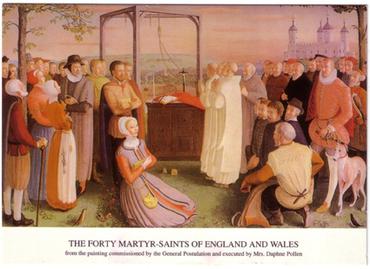
Ambrose Edward Barlow was hanged, dismembered, quartered and boiled in oil for his religious beliefs. He was one of the Forty Martyr-Saints of England and Wales and his feast day is Oct. 25th. (see painting above).


Ironically, my 6th great grandmother, Hannah Perry (from Admiral Perry's family), was a direct descendant of Sir William Wallace, a Scottish hero from the 13th century.


William Wallace is one of Scotland's greatest national heroes, undisputed leader of the Scottish resistance forces during the first years of the long and ultimately successful struggle to free Scotland from English rule at the end of the 13th Century.

http://www.electricscotland.com/history/articles/william_wallace.htm


He was also hanged, dismembered, quartered, and had his body parts put on display by the British. Today, there is a huge tower known as Wallace tower, in honor of Sir William Wallace.


(The Wallace Monument, near Stirling, Scotland. Photo by Finlay McWalter, of Scotland, on Wikipaedia.)

Hannah (1728-1795) lived in New Jersey during the American Revolution. Another member of Ancestry.com posted this family story:
Both her husband, Aaron and son, Ephraim were soldiers in the Revolutionary War. Son Aaron was a Minuteman. Hannah plowed all one day while a battle was going on in which both Aaron and Ephraim were fighting. She could hear the cannons roar, but told the children it was thunder. She herself, was too distressed to eat.


You can read a transcript of Clyde E. Williams, Sr. (Mark's paternal grandfather) on "This I Believe" (we have the vinyl LP with the original recording). Mark's maternal grandfather, William Van Aken, was the mayor of Shaker Heights, Ohio, for 40 years.


I also searched information for my children on their father's side (Merlin and Lyon). (There was little on the Merlins, but much on the Lyon side of my sons’ family tree, including the fact that the Lyon ancestors were Loyalists or “Torries” who favored the British crown during the American Revolution. After the Revolution, they settled near Kingston, Ontario, on lands granted to them by the King of England.


How interesting to see how our families were part of history... I found documents telling how one of my ancestors was at the first funeral for a white person in the Youngstown, Ohio, area. I also found out, sadly, that perhaps the brother (the relationship is, as online records show, debatable) of one of my ancestors was part of the Massacre at Mystic, CT (May 26, 1637). I would like to visit the Pequot Museum...I wonder how that would feel and what I might learn.

For, in my family's history, and in all of our histories I suppose, there is good and bad. The "let's remember" and the "let's forget." But all of these events tie us to our neighbors, our country, our land, and our descendants.

The second full day of my search, I called my mother early in the morning, tears in my eyes and my throat choking up. "I wish Dad could be here to go through this information with me. He would have loved finding out about his ancestors."


And he would have loved it! Dad (in photo at left and below with my mother and sons) died in 1990, before most folks had a computer in their home and instant access to so much. I'm sure if he'd had the opportunity he would have researched his family history and then written in all out in his careful engineer's printing. I would have asked him to tell me his childhood memories, such as they were, and I would have written them down.


In any case, I'm glad for the chance to learn about our family now, and share this with my sisters, my mother, my sons, my husband...and you! I am thankful for all the people in history and in the present who have documented and researched information so that I might learn about my family.

If you have any interest in learning about your family history, give ancestry.com or another family history site a try. You might be surprised at what you learn!

June 6, 2011

Childhood Toys

Melissa Kline asked me recently if I had any toys from my childhood. A few... and so we decided to each do a blog post today on this subject. Please visit Melissa's blog at: http://www.melissakline.blogspot.com/.


Above: Here is one of three plates my father gave to me during my teen years, along with the two remaining pieces from my childhood tea set.

As a small child, I spent time at my cousin, Wanda's, house. She was of my parents' generation, so I always called her Aunt Wanda. Wanda was a registered nurse, and years later (when I had children) we lived near each other in Florida; so my children also got to spend time with her.

I remember as a preschooler planting bulbs with my red-haired aunt and walking down the street, each of us holding one hand of my stuffed toy monkey. The two cast iron figures above always sat on Aunt Wanda's windowsill in her kitchen. If you look closely, you might be able to see the small marks, where the paint is gone...this is from my teething. Nowadays, a loving aunt, let alone a registered nurse, would probably not let her toddler charge put a painted, iron 2.5-inch figurine in her mouth. Then, I don't think we thought much of it at all!

Friends of my parents traveled to Australia in the 1960s and brought back this stuffed bear for me. I loved it, and imagined a land far, far away populated with lovable bears who smell, certainly, just like the wonderful smell of this bear. Its hard little body was not very cuddly, but I loved the exotic promise it held and, oddly, I never considered from what animal the real fur of this toy might have originated.

The only book I have from my childhood is one tiny book, part of a boxed set of books, by Maurice Sendak: "One Was Johnny." Another book in the series was about a boy named Pierre who always said "I Don't Care!" This book made a big impression on me, and I remember feeling as a child that it was wrong not to care about something. That it was better to have an opinion than be apathetic, and also that it was better to care what happened to you and your life, than be passive. Perhaps those feelings started from reading Sendak's little book!


By the time a woman has lived in 9 towns in two far-apart states, as well as raised two children with all of their things, and carted around a lifetime of art supplies and books, there isn't much room for toys. Here are two tiny things that reside in a small curio shelf in our home. The baby bracelet given to me in the hospital when I was born. By the time my sons came along beaded bracelets for infants were a no-no; but there is something so sweet to me about these little beads spelling out my name. How small my wrist was!

This little hanger was made by my grandfather. He made wooden doll furniture and a pastel blue toy kitchen cupboard for me, as well as a cast iron pancake pan that I used often on a hot plate when I was in college. I was skinny then, but often made pancakes on the weekends in my room at Engleman Hall at Kent State while an art student.

Toys I wish I still had: Liddle Kiddle dolls, a stuffed dog that sat on my bed, his name was "Morgan" (my older sisters still have theirs).

Thanks, Melissa, for the trip down memory lane. Folks, please pop over and see Melissa's childhood toys: http://www.melissakline.blogspot.com/. And, if you know a teenager who needs some good summer reading, consider My Beginning, Melissa's forthcoming debut YA novel. You can pre-order it now on Amazon.

June 1, 2011

Daisy Mae, you were so very much loved...


My dear friend, Florence Clark, has shared with me that her beloved dog, Daisy, left earth in May. I wrote about Daisy on Appalachian Morning in 2009, you can see the article here. Since 2009, Flo has keep me posted on Daisy's wonderful antics and also her loving spirit as she has been such a support and help to Flo over the years. I've seen the photos, drawings, paintings, and sculptures Flo has done of Daisy and celebrated with her the transformation of the spirit of love into the visible form of works of art. And celebrated Daisy, who will be very much missed.
Here are some images and a poem from Flo.


BABY GIRL #4

I spend most of my time alone
alone..but not
lonely:
WE are almost always
Together

We know everything about
each other
WORDS are not necessary,
although I believe you understand
Everything.

You and I understand
the meanings in:
The smallest
movements-
the softest sounds-
the daily routines-
of our other
-The
You-
that is the other half of
-We-

The one who
knows
Everything
About me